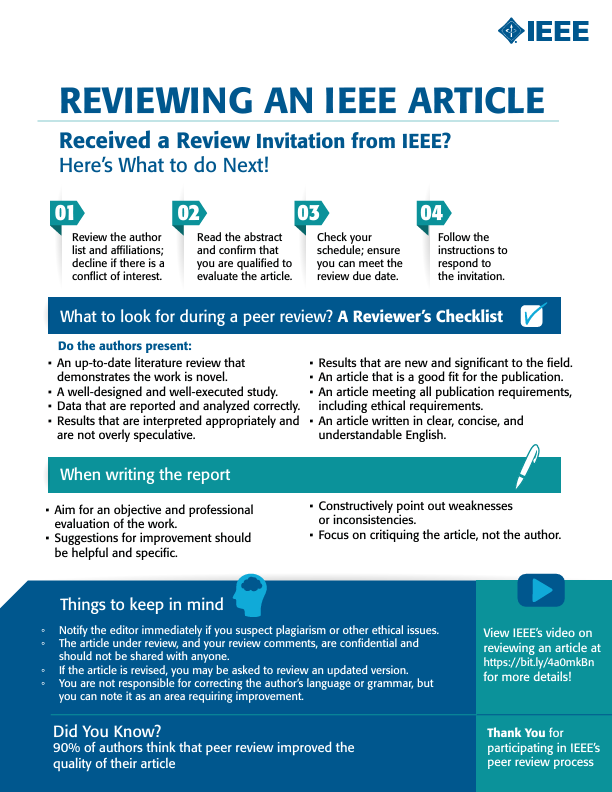
Reviewers play a vital role in IEEE publishing by providing expert, constructive evaluations of submitted articles. By serving as an IEEE reviewer, you can:
Help improve the technical quality of a colleague’s work before publication
Actively contribute to advancing research in your field
Give back to your community by reciprocating for past reviews of your own work
Hone your writing and critiquing skills
Thank you for volunteering your time and expertise to advance research in your field.
These guidelines outline the peer review process and provide the essential information reviewers need to complete their assessments and recommendations.
Signing Up To Be a Reviewer
To be considered as a reviewer, you must create an account on the submission site of the publication for which you would like to review. (If you do not know which publication is most suitable for your interests and needs, please visit our IEEE Publication Recommender for suggestions.) When creating your account, choose keywords that accurately describe your areas of expertise to ensure that the review invitations you receive are in your field. Once your account is created, your name will be added to that publication’s pool of potential reviewers.
The IEEE Peer Review Process
Once an article passes through IEEE’s prescreening process, it is evaluated by at least two independent, qualified reviewers. You were invited based on your expertise and, when applicable, your record of providing timely, high-quality reviews.
Ethics of Peer Review
IEEE upholds the highest standards of fairness, integrity, and professionalism. Authors, editors, and reviewers are expected to follow IEEE’s ethical principles.
Author Misconduct
Examples include:
Plagiarism: Using others’ work without proper attribution.
Duplicate publication: Republishing previously published material without acknowledgment.
Parallel submission: Submitting the same article to multiple venues simultaneously.
Data fabrication or falsification: Inventing, altering, or omitting data.
Image manipulation: Altering images in ways that misrepresent findings.
Inappropriate authorship: Adding or omitting authors improperly.
Citation stacking: Including irrelevant references to boost citations.
If you suspect misconduct, notify the editor immediately. Your anonymity will be preserved.
Reviewer Misconduct
Reviewers must avoid:
Breach of confidentiality: Sharing or using unpublished content for personal gain.
Summary: Briefly restate the article’s purpose and findings.
Major concerns: Issues with methodology, data, or analysis.
Minor concerns: Issues with clarity, structure, or presentation.
Overall feedback: Strengths, weaknesses, and recommendation.
Note that reviewers are not permitted to suggest irrelevant references or an excessive number of references. Any suggestions to add more references should be accompanied by reasons why those references should be added.
If the article is too poorly written to evaluate, notify the editor.
Tips
Be professional, objective, and constructive.
Provide specific, actionable feedback.
Support your comments with clear reasoning and examples.
Write the kind of review you would value receiving.
Using Artificial Intelligence (AI) Tools
Do not use AI tools (e.g., ChatGPT, Gemini) to generate or draft reviews. Articles under review are confidential, and reviewers are responsible for their own evaluations. You were selected for your expertise, not for outsourced judgment.
Making a Recommendation
As part of your review, you will be asked to make a recommendation regarding whether the article should be accepted for publication. Decision names may vary across IEEE publications but they can be categorized into one of three types: accept, revise, or reject.
Accept: The article meets IEEE standards for publication with no changes needed.